Choosing the right cloud strategy is one of the most important technology decisions a business can make. When comparing Hybrid vs Public vs Private Cloud, it is essential to understand how each model impacts security, cost, scalability and operational control.
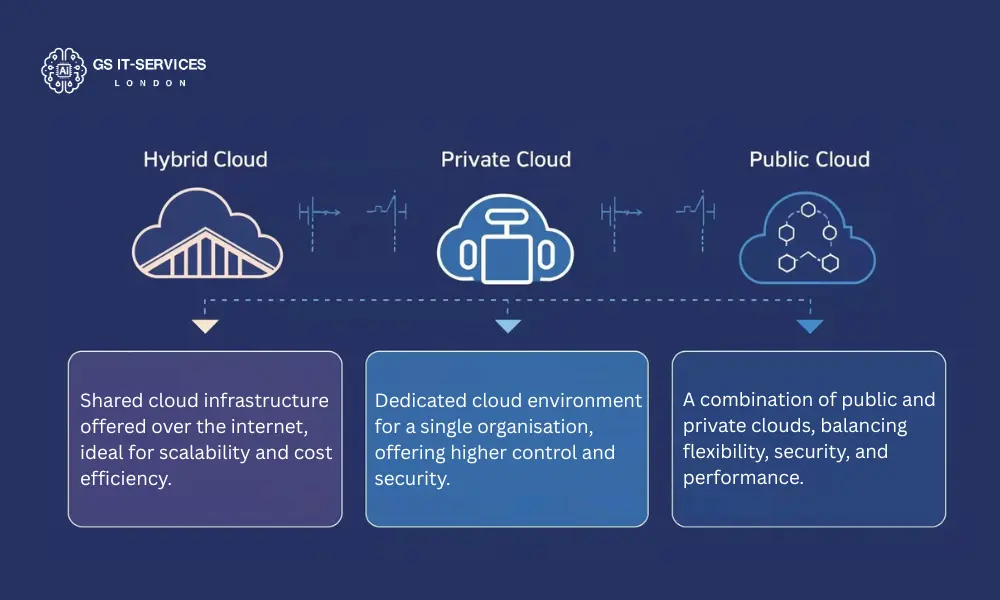
Public cloud offers flexible, pay-as-you-go infrastructure managed by third-party providers. Private cloud delivers dedicated environments designed for enhanced security and compliance. Hybrid cloud combines both approaches, allowing businesses to balance performance, protection and cost efficiency.
In this guide, we break down Hybrid vs Public vs Private Cloud in clear, practical terms, helping UK businesses determine which cloud deployment model aligns best with their growth plans and IT requirements.
What is Public Cloud?
Public cloud refers to cloud services offered by third-party providers like Microsoft Azure, Amazon Web Services (AWS), or Google Cloud. These providers own and operate the infrastructure, which they share across multiple customers.
Advantages of Public Cloud:
- Cost-effective: Pay-as-you-go pricing means you only pay for what you use, which is great for businesses looking to avoid large upfront costs.
- Scalability: Public clouds can scale up or down instantly to handle fluctuating workloads.
- Accessibility: Users can access resources anytime, anywhere, which supports remote and hybrid working models.
Challenges:
- Security concerns can arise because infrastructure is shared, although major providers invest heavily in robust security measures.
- Less customisation and control compared to private or hybrid options.
Public cloud is ideal for startups, small businesses, or projects with unpredictable workloads that require fast scaling without heavy capital investment.
Interested in migrating to the public cloud while keeping your data secure?
Contact GS IT Services for Expert Cloud Migration Support
What is Private Cloud?
A private cloud is a cloud infrastructure dedicated solely to one organisation. It can be hosted on-premises or by a third-party provider but is not shared with others.
Advantages of Private Cloud:
- Enhanced Security and Control: Because the resources are exclusive to your business, you have greater control over security protocols, compliance, and customisation.
- Compliance-Friendly: This makes private cloud suitable for industries with strict regulatory requirements such as finance, healthcare, or legal sectors.
- Performance: Dedicated resources often mean more consistent performance.
Challenges:
- Generally more expensive due to dedicated infrastructure and maintenance costs.
- Less scalable and flexible compared to public or hybrid clouds, which can impact responsiveness to changing business needs.
Private cloud solutions are a great fit for UK businesses prioritising security, compliance, and customisation, with budgets to support these needs.
Looking for tailored, secure cloud infrastructure?
Explore GS IT’s Private Cloud Solutions Today
What is Hybrid Cloud?
Hybrid cloud combines the best of both worlds — it integrates public cloud and private cloud environments. Businesses can keep sensitive data and critical applications in a private cloud, while leveraging the public cloud for non-sensitive workloads and scalability.
Benefits of Hybrid Cloud:
- Flexibility and Agility: Businesses can quickly move workloads between private and public clouds depending on demand, regulatory requirements, or cost considerations.
- Optimised Cost Management: You can keep sensitive data in the private cloud for security, while using the public cloud for less critical tasks to reduce expenses.
- Business Continuity: Hybrid setups improve resilience by allowing failover between cloud environments in case of outages.
- Supports Innovation: Easily adopt new cloud services and AI-powered tools in the public cloud without compromising sensitive data.
Challenges:
- Requires careful management and integration of multiple environments.
- May need advanced IT expertise to maintain security and performance across clouds.
For many SMEs and enterprises, hybrid cloud provides the ideal balance of control, security, and scalability, enabling them to respond dynamically to market changes.
Ready to leverage hybrid cloud for competitive advantage?
Speak with GS IT’s Hybrid Cloud Experts
Difference between Hybrid vs Public vs Private Cloud
| Feature | Public Cloud | Private Cloud | Hybrid Cloud |
| Cost | Lower upfront costs, pay-as-you-go | Higher initial investment | Balanced cost, optimised spend |
| Security | Shared environment, strong provider security | Dedicated environment, full control | Customised per workload, balanced security |
| Scalability | High, instant scalability | Limited by infrastructure | Highly scalable with flexibility |
| Control | Limited customisation | Full control | Flexible control depending on workload |
| Compliance | Suitable for general use | Suitable for strict regulations | Can meet regulatory needs selectively |
| Use Case | Startups, fluctuating workloads | Regulated industries, sensitive data | Businesses needing flexibility and security |
Related Article: Is Your SME Ready for GenAI?
How AI Enhances Cloud Computing Models
The integration of AI into cloud platforms is revolutionising how businesses operate. AI-powered cloud solutions enable smarter automation, predictive analytics, and enhanced security monitoring.
- AI and Automation: Automatically optimise resource allocation based on workload patterns, saving costs and improving efficiency.
- AI-Driven Security: Advanced threat detection powered by machine learning can proactively identify and mitigate cyber risks.
- Data Insights: AI tools help businesses gain deeper insights from data stored in cloud environments to drive better decisions.
By choosing the right cloud model combined with AI capabilities, businesses gain a competitive advantage that fuels innovation and growth.
Advanced Cyber Security Services in London
Protect your data with AI-driven threat detection and prevention.
Key Takeaways: Choosing Your Cloud Strategy
- Public Cloud suits businesses needing low-cost, scalable solutions with minimal management overhead.
- Private Cloud is best for organisations demanding high security, compliance, and control over data.
- Hybrid Cloud offers the most flexibility by allowing businesses to balance cost, security, and scalability based on their specific needs.
Every business is unique, so a tailored cloud strategy designed with expert advice ensures you get the most value and security.
Related Article: AI-Driven Cybersecurity for SMEs
Why Choose GS IT Services for Your Cloud Needs?
GS IT Services is a London-based Managed Service Provider offering AI-driven IT support, cloud computing, cybersecurity, and consulting services designed specifically for UK SMEs and enterprises. Our expert team helps you navigate the complexities of cloud adoption with:
- Personalised Cloud Strategy tailored to your business goals.
- Secure Hybrid Cloud Solutions that maximise flexibility and control.
- Seamless Cloud Migration with minimal downtime and disruption.
- Proactive AI & Automation to optimise your IT environment.
We make switching to smarter cloud solutions simple and affordable, supporting your business every step of the way.
Take the first step in your cloud transformation today!
Book a Free Consultation with GS IT Services or call 0203 576 3830.
FAQs : Hybrid vs Public vs Private Cloud
Q: Can I switch from public to hybrid cloud later?
A: Absolutely. Many businesses start with public cloud and gradually adopt hybrid setups as their needs grow.
Q: Is hybrid cloud more expensive than public cloud?
A: While hybrid cloud can involve additional management, the optimised use of resources often balances overall costs.
Q: How does hybrid cloud help with compliance?
A: Hybrid cloud lets you keep sensitive data in private environments while leveraging public cloud benefits for less sensitive workloads.